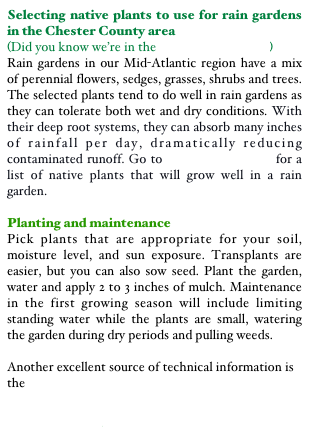
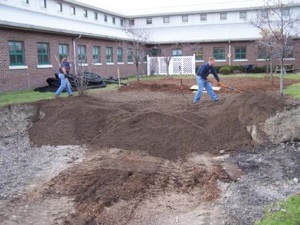
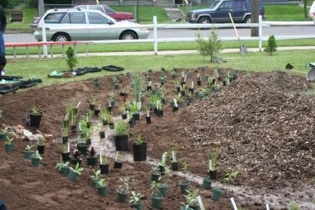
Installing a Rain Garden —Some basic steps


Your home nature sanctuary
Plants native to our area will attract the butterflies, beetles, frogs, turtles, toads, and birds that depend on them for their food and homes. 96% of North American birds rely on insects, and the spiders that eat them, to feed their young. These insects are plant specialists and can only survive on native species for their food. They simply can’t eat the alien plants we typically buy from the nursery and grow in our home gardens. Mulch and then water your planting every other day for the first few weeks, until plants are growing and well-established. Once your native plants are established, they’ll thrive well without additional watering.
protecting the watershed in
When we see land as a community to which we belong, we may begin to use it with love and respect.
—Aldo Leopold
Rain gardens may vary greatly in size, soil type and plant selection, but the basic steps are the same.
These photos are taken from The Rain Garden Initiative. http://www.raingardeninitiative.org/raingardens.html
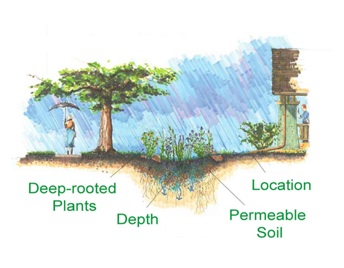
THE FOUR KEY FEATURES
to consider when planning a rain garden are
location, deep rooted plants, depth and permeable soil

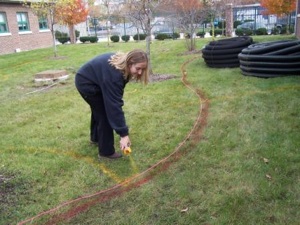
Picking a location
Select a low-lying site where rain flows during a storm at least 10 feet from any building. Ideally it should be located between the source of runoff (roofs and driveways) and the runoff destination (drains, streams, low spots), also where water naturally pools after rain but dries up in 24 hours. Place at least 25’ from a septic system drainfield or well head. Make sure to avoid underground utility lines. You may direct your downspout to your rain garden, either by digging a shallow swale or by routing it through a buried 4” PVC pipe. Full sun is best, but make sure the site gets at least a half-day of sunlight. Determine the area of roof, driveway, patio, etc., that will be drained by the rain garden.
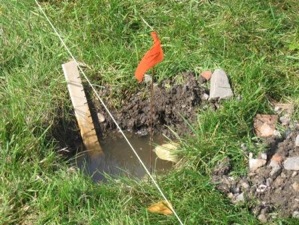
Some people make the step of determining how quickly the soil will drain by performing a percolation test. This will indicate the maximum bed depth that will drain in 24 hours for the existing soils. The slope of the site is also a factor in determining the bed depth.

The drainage area, bed depth, type of soil and distance from the downspouts can be used to determine the area of the rain garden. (The calculations are explained in several rain garden construction manuals available online.)
Simple construction
Mark the boundary of the garden with paint or string. Till or double dig the basin 4” to 6” deep with sloping sides, graded toward the center. If needed, build slight earth berms around the downhill side to retain water. Rain gardens work best when constructed in well-drained soil. If the soil is compacted, it may need to be dug deeper to loosen the soil. Amend with compost, sand and topsoil if necessary. Mulch the surface. Re-test the infiltration of water to make sure that the basin drains in 24 hours.